








Most festivals start with joy. Argungu started with blood.
For centuries, the Sokoto Caliphate and the Kebbi Kingdom were enemies. Wars. Raids. Generations of conflict. The kind of rivalry that destroys nations.
1939 marked the beginning of a new era.
Instead of choosing another battle, they chose the river. They chose fishing. They chose peace.
The pioneers didn’t know it then but they built one of Nigeria’s most spectacular cultural festivals.
Matan Fada River: The Peace Symbol
The Argungu International Fishing and Cultural Festival didn’t start as entertainment. It started as reconciliation.
After centuries of hostility between the Sokoto Caliphate and the Kebbi Kingdom, leaders needed a reason for peace. Something that would unite communities, not divide them. Something that honoured tradition and the shared heritage of all stakehoders.
They found it in the Matan Fada River.
Fishing had always been part of life in Kebbi State. The river fed families. It connected villages. It was neutral ground.
So in 1934, the first Argungu Fishing Festival was held. Not as a competition. As a peace treaty signed in water.
Sultan Dan Mu’azu of the Sokoto Caliphate attended. The visit was historic. It signalled the end of an era.
And it worked.
Nearly 100 years later, the festival is still going. Now in its 61st official edition, it attracts visitors from Europe, America, Asia, and across Africa. In 2026, President Bola Ahmed Tinubu will headline as special guest of honour.
The world comes to Argungu. Not for war. For culture.
What Happens At Argungu.
The festival runs for four days every February. It marks the end of farming season and the start of fishing season. But it’s more than agriculture. It’s identity.
Here’s what happens:
Day 1-3: Traditional Sports and Cultural Displays
• Camel racing
• Donkey racing
• Canoe racing
• Wrestling (Dambe boxing)
• Archery and catapulting
• Wild duck hunting
• Swimming competitions with calabash gourds
• Diving contests (competitors stay underwater as long as possible)
• Agricultural showcases
• Traditional music and dance performances
Day 4: The Grand Fishing Finale
This is what everyone waits for.
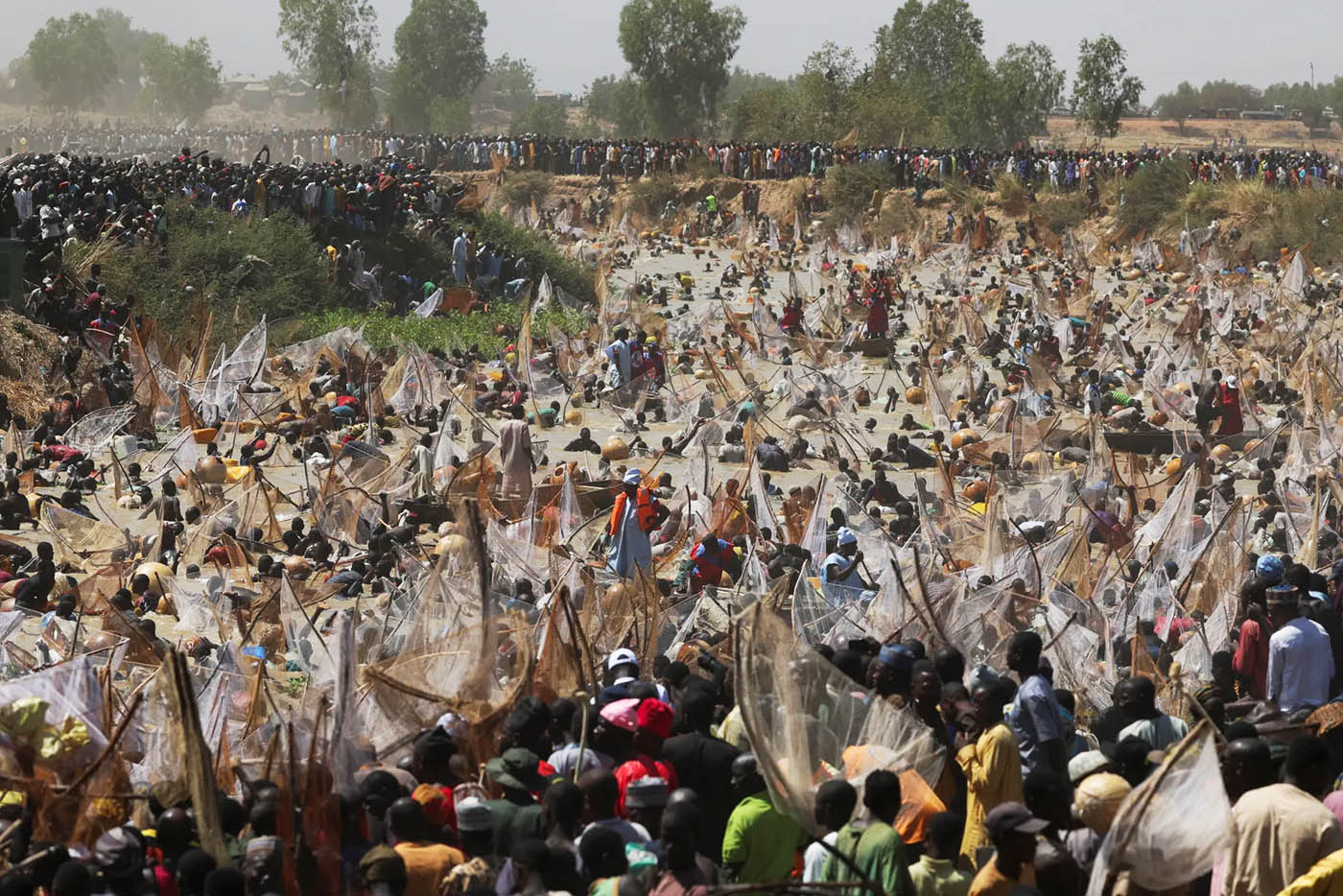
Over 5,000 fishermen gather along the Matan Fada River. They come from across Nigeria and beyond. Some are professionals. Some are young boys proving themselves. All of them carry the same tools: calabash gourds and traditional hand nets.
Modern fishing equipment is banned. This is about skill, not technology.
At the sound of a gunshot, they dive in.
One hour. Thousands of fishermen. One goal: catch the biggest fish.
Drummers float by in canoes. Men rattle seed-filled gourds to drive fish toward shallow water. Nets fly. Bodies disappear underwater. The crowd roars.
The winner? In 2020, the fisherman who caught the largest fish; weighing 78 kilograms, won N10 million, two brand new cars, and two seats for Hajj. The biggest fish ever caught at Argungu was 75kg in 2005. It took four men to lift it.
After the competition, everyone sings and dances into the night.
The Silent Spiritual Side.
Before any fish can be caught, there’s a ritual.
The Sarkin Ruwa, (the custodian of the river) must give permission. He performs sacrifices to the river oracle. He dispels crocodiles. He invites fish from connected rivers to gather at Matan Fada.
Without his blessing, no competition happens.
This isn’t superstition. It’s respect. The river isn’t just a resource. It’s a living part of the community. The Sarkin Ruwa ensures balance. He ensures safety. He ensures tradition is honoured.
That’s what makes Argungu more than a festival. It’s a covenant between its people, culture, and nature.
Why The World Recognizes Argungu.
In recognition of its cultural significance, UNESCO designated the Argungu Fishing Festival as an Intangible Cultural Heritage of Humanity.
That’s a big deal.
It means Argungu isn’t just important to Nigeria. It’s important to the world. It represents something rare: a centuries-old tradition that has survived modernization, conflict, and changing times.
The festival showcases:
• Conflict resolution through culture (not violence).
• Community unity across ethnic and religious lines.
• Traditional knowledge preservation (fishing techniques passed down for generations).
• Economic empowerment (tourism, local commerce, agricultural trade).
• Youth participation (keeping traditions alive for the next generation).
Every year, tourists from Britain, Russia, the United States, South East Asia, and neighbouring African countries like Niger, Cameroon, and Benin Republic flock to Argungu. Hotels fill up months in advance. The town transforms.
Argungu isn’t just cultural. It’s economic.
The festival brings infrastructure development to Kebbi State. Roads improve. Hotels expand. Local farmers and artisans showcase their products to thousands of visitors. Agricultural trade fairs generate commerce that lasts beyond the four days.
The 2026 edition features expanded agricultural exhibitions. Farmers display grains, livestock, and innovations. Women farmers discuss irrigation techniques and cooperative associations. It’s tradition meeting progress.
One female farmer at the 2026 festival said: “This has made us family. We are not competing with our husbands. Through association, we learn modern farming methods. We have grasslands we couldn’t use before. Now we grow vegetables and take them to market.”
That’s the power of Argungu. It doesn’t just preserve the past. It funds the future.
Young People Keeping Tradition Alive.
Walk along the Matan Fada River during the festival and you’ll see something striking: youth everywhere.
Young boys dive underwater, holding their breath until spectators worry. Young men race canoes with incredible speed. Teenagers wrestle in traditional Dambe boxing matches. Girls swim while balancing calabash gourds on their heads.
This isn’t performance. It’s life. These young people aren’t mimicking their ancestors. They’re living the culture.
And they’re keeping it alive for the next generation.
What Argungu Teaches Nigeria.
Every country has conflict. Not every country turns conflict into culture.
Argungu is proof that Nigeria knows how to choose peace. Not through treaties signed in distant capitals. Through rivers, fishing nets, and community.
The festival started in four religious rites: Gyaran Ruwa, Fashin Ruwa, Gyaran Gari, and Shan Kabewa and Fura. These rites were communal affairs long before 1934. They were how people marked seasons, celebrated harvests, and honoured the river.
When the Sokoto Caliphate and Kebbi Kingdom needed peace, they didn’t invent something new. They returned to what already worked: shared tradition.
That’s Nigerian wisdom.
The Road Ahead.
The festival was suspended from 2009 to 2020 due to rising banditry and insurgency in the region. But in 2020, it returned. And it came back stronger.
Governor Nasir Idris has invested in infrastructure to make the 2026 edition even bigger. President Tinubu’s attendance signals federal government support. International media coverage is expanding.
Argungu is no longer just a Kebbi State event. It’s a national treasure. An African icon. A global heritage site.
And it all started because two kingdoms chose the river over the battlefield.
This isn’t a festival you watch from the sidelines. It pulls you in. You’ll hear drumming echo across the water. You’ll see fishermen emerge victorious, hoisting massive Nile Perch overhead. You’ll feel the weight of 600 years of history that chose culture over conflict.
You’ll understand why UNESCO recognized it.
You’ll understand why Nigeria celebrates it.
The Bigger Picture.
Argungu proves something important: Nigerian culture isn’t something to preserve in museums. It’s alive. It’s economic. It’s unifying. And it’s ours to tell.
The festival has placed Kebbi State as one of Africa’s major tourist destinations. It brings revenue, visibility, and pride to the entire region.
But more than that, it reminds Nigeria- and the world – that our traditions have power.
Power to end wars. Power to build economies. Power to pass wisdom from generation to generation.
Power to turn rivers into peace treaties.
This is Nigeria. This is culture. This is Argungu Festival.